
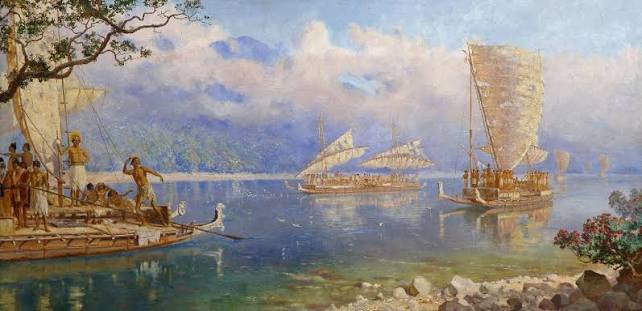
As the nineteenth century neared its end, the British colony of New Zealand was still relatively young. Although the New Zealand Wars had largely ended by the 1870s, disputes over land, political authority, and Māori’s position within the colony continued.[1] Against this background, colonial scholars debated how Māori and European histories were connected and how both groups fitted into the developing society. These questions formed the basis of a theory proposed by colonial scholar and public servant Edward Tregear, who “proudly asserted” that Māori and Europeans belonged to the same ancient Aryan bloodline.[2]
Published in 1885, Tregear’s The Aryan Māori attempted to establish a historical connection between Māori and European peoples through language, mythology and migration. Although the theory attracted considerable attention, it additionally generated controversy over the evidence used to support it. The debate revealed how European ideas about race and civilisation shaped colonial scholars’ interpretations of Māori history and identity.
By the time of publication, Edward Tregear was an influential figure in nineteenth-century New Zealand’s intellectual circles. Immigrating from England in 1863, Tregear began his career in the colony as a surveyor for the Auckland Engineer Volunteers, a role that required him to travel frequently across New Zealand and interact with local Māori tribes (iwi).[3] Through this work, he developed knowledge of the Māori language, its history and culture. Although he never held a university position, he became involved in New Zealand’s intellectual networks, including the Wellington Philosophical Society in the capital. Furthermore, he maintained connections with British scholarly organisations. These connections helped his work circulate beyond New Zealand and placed it within wider networks of colonial and imperial scholarship.[4]
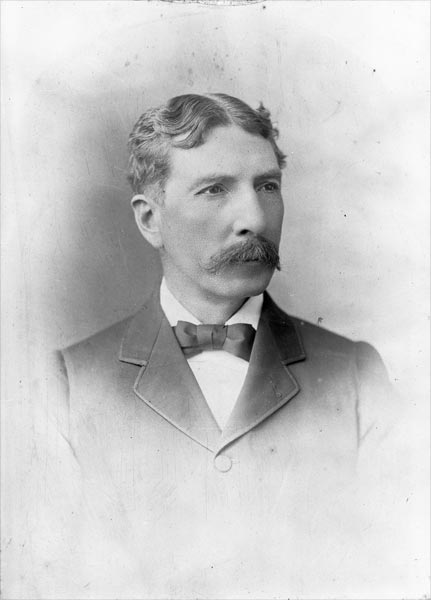
Edward Tregear (1846-1931)
A New Zealand public servant, scholar and writer whose interests included the Māori language, comparative linguistics and Polynesian history.
Tregear’s increasing knowledge of Māori coincided with a wider intellectual interest in comparative linguistics across the Western world. Tregear drew inspiration from German philologist Max Müller, whom he described at the beginning of The Aryan Māori as the “great German thinker”. Müller argued that languages such as Sanskrit, Greek and Latin descended from a common ancestral language, helping establish the concept of an Indo-European language family.[5] These discoveries encouraged further investigations into the dynamics between language, migration, and human ancestry.
The term Aryan, while initially just having linguistic and historical associations, became increasingly entangled with European ideas of racial classification and theories concerning civilisations. Although, as Howe explains, Tregear was not the first to apply Müller’s theory to New Zealand, his distinctive style and enthusiasm helped make New Zealand and its Indigenous people appear less strange and unknowable to European audiences.[6] Tregear believed he had cracked the code, finding this place permeated with remnants of a shared Aryan past.
But what did Tregear claim? His argument was unusually ambitious. In his introduction, he makes four positive assertions:
- That Māori were Aryan; that their language and traditions demonstrated descent from a pastoral and migratory population.
- That Māori had preserved the language of their supposed Aryan ancestors.
- That this language retained memories of animals and objects no longer familiar to Māori.
- That the Māori left India around four thousand years ago and had settled in New Zealand for almost as long.[7]
These claims highlight Tregear’s attempt to reconstruct more than a linguistic relationship between cand Europeans. He wanted to use language as a tool to resurrect an entire account of ancient migration and everyday life.
One example is his comparison of the Latin word taurus, meaning bull, with many Māori words beginning with tara- or tar-. Tregear associated tara with courage, tararau with making a loud noise, tararua with having two points or peaks, and taru with eating grass. He interpreted these words as surviving remnants of an ancestral vocabulary linked to cattle and pastoral lifestyles.[8]
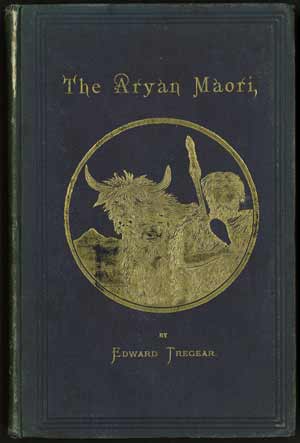
Look a Little Closer
The depiction of the Māori in traditional garments and the cattle echoes Tregear’s own correlations to the language having clues to a distant pastoral ancestry.
The justification was that the Māori language preserved traces of animals encountered by their ancestors before their migration into the Pacific, despite cattle being a non-endemic species in pre-European New Zealand. Tregear believed linguistic remnants revealed aspects of a past that could no longer be directly observed.[9]
The example is revealing because it shows how Tregear moved from word resemblance to conclusions about ancestry and migration. He was not simply suggesting that two words sounded alike. He treated those similarities as evidence of a shared history and used them to reconstruct the experiences of an ancient population.
But why did this theory matter in the grand scheme of things? Tregear’s argument connected Māori history to a wider European narrative concerning human origins. Historian James Belich describes this theory as a direct challenge to earlier notions that Māori and Europeans had separate histories and cultural practices. However, it operated within conservative frameworks of European racial interpretation.[10] This theory also shaped how settlers understood New Zealand. In the late nineteenth century, Pākehā settlers (Māori for person of European descent) developed a stronger sense of national identity, as the 1880s marked the first time the census recorded more births on New Zealand soil than immigrants. Through this, they sought to form a historical narrative that connected them to the country.[11] While Māori history offered important depth, Europeans interpreted it through their own ideas of assimilation and intellectual assumptions.
Tregear’s idea of shared ancestry opened the door to a possible connection. It allowed Māori history to fit within a broader account of the nation’s past, while also fitting Māori into categories familiar to European scholars. This apparent inclusion did not necessarily challenge colonial inequalities or recognise Māori authority over interpreting their own histories.
However, Tregear’s theory alone did not enable these ideas or directly determine colonial policy. Its significance lies in its contributions to the wider intellectual environment of New Zealand and the British Empire, where the dynamics between race, culture, and national belonging could be debated through a common thread.
Tregear’s claims, however, were not universally embraced. His linguistic methodology was perhaps the most criticised. Specifically, his fellow amateur philologist and lawyer, A. S. Atkinson, published a detailed response in 1886 in the Transactions and Proceedings of the New Zealand Institute, the official research journal at the time for scientific societies across New Zealand. Atkinson’s primary complaint was that comparative linguistics could not establish the strong historical relationship Tregear proposed.[12]
This controversy was not reduced to whether Māori and European shared an ancient ancestry. It concerned the evidence and methods used to establish such a claim. Tregear’s argument provides a starting point for examining how colonial scholars negotiated scientific authority, and why interpretations of Māori origins matter beyond the study of language.
The next post examines Atkinson’s criticism and Tregear’s response, exploring the competing methods that made the Aryan Māori theory so controversial.
[1] Richard S. Hill, “Settler Colonialism in New Zealand, 1840–1907,” in The Routledge Handbook of the History of Settler Colonialism, ed. Edward Cavanagh and Lorenzo Veracini (London: Routledge, 2016), 397.
[2] Edward Tregear, The Aryan Māori (Wellington: George Didsbury, Government Printer, 1885), 5.
[3] K. R. Howe, Singer in a Songless Land: A Life of Edward Tregear, 1846–1931 (Auckland: Auckland University Press, 1991), 17–18.
[4] Tim McKenzie, “Edward Robert Tregear, 1846–1931,” Kōtare: New Zealand Notes & Queries 7, no. 3 (2008), 32.
[5] Tregear, The Aryan Māori, 1; Howe, Singer in a Songless Land, 45–46.
[6] Howe, Singer in a Songless Land, 49–50.
[7] Tregear, The Aryan Māori, 5.
[8] Tregear, The Aryan Māori, 31-33.
[9] Tregear, The Aryan Māori, 68.
[10] James Belich, “Myth, Race, and Identity in New Zealand,” New Zealand Journal of History 31, no. 1 (1997): 10.
[11] Ron Palenski, The Making of New Zealanders: The Evolution of National Identity in the Nineteenth Century (PhD diss., University of Otago, 2010), 13; Belich, “Myth, Race, and Identity in New Zealand,” 10.
[12] A. S. Atkinson, “The Aryo-Semitic Māori,” Transactions and Proceedings of the New Zealand Institute 19, no. 1 (1886): 554.


Leave a Reply