
Following from Blog 1, Tregear’s The Aryan Māori attracted considerable attention inside and outside the colony after its publication. However, not everyone accepted his ambitious claim that Māori and Europeans were long-lost relatives.
One critic, amateur linguist and lawyer A. S. Atkinson, took particular issue with Tregear’s linguistic evidence. In an 1886 article titled “The Aryo-Semitic Māori,” Atkinson questioned whether the similarities Tregear identified between Māori and European languages could genuinely establish a shared ancestry.[1] His criticism was deliberately provocative. In response to Tregear’s comparisons, he sarcastically remarked that:
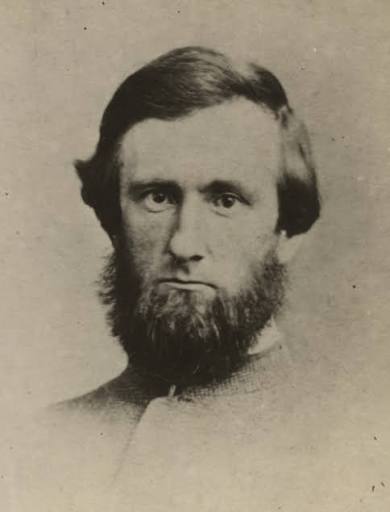
“The whole Aryan menagerie files out of this ancient, but heretofore unsuspected, Noah’s Ark—the Māori language.”[2]
-A.S. Atkinson (as pictured here)
Atkinson was suggesting that Tregear had discovered an entire Aryan world hidden within the Māori language. The humour exposed a serious problem with Tregear’s approach: if linguistic similarities could be selected freely, they could be used to construct almost any account of ancestry.
He begins his article by outlining Tregear’s central argument: that Māori belonged to the same ancestral family as Indo-European or Aryan populations, and that the Māori language preserved an ancient form of their common ancestral speech. He recognised the “startling” scale of Tregear’s claim, noting that the author attempts to apply Müller’s methods and establish a relationship between Polynesian and Indo-European languages.[3]
Atkinson questioned whether similarities in sound and meaning were sufficient evidence to establish a historical linguistic relationship.[4] His criticism was not just that individual comparisons were unconvincing. Rather, he argued that Tregear’s approach could be applied so freely that it risked producing almost any desired conclusion. Essentially, Atkinson argued that Tregear cherry-picked words to suit his argument rather than establishing the relationship through legitimate linguistic analysis.
The comparison between Latin taurus and Māori words such as tara, tararau and taru, discussed in the previous post, provides a useful example. Tregear treated these similarities as evidence that Māori ancestors once lived in pastoral societies like Indo-Europeans.[5] What makes the comparison striking is the distance between the words themselves and the conclusion Tregear wanted them to support. Words associated with courage, noise, points and grass became evidence of an ancestral connection to cattle.
Atkinson argued that similarities in sound and meaning can appear between languages without demonstrating a genuine historical connection. To expose this problem, he applied Tregear’s method to construct an alternative explanation of Māori ancestry. The title itself, “The Aryo-Semitic Māori,” was deliberately provocative: he proposes that the same comparative methods could be used to show that Māori also have Semitic alongside Aryan connections.[6] He further described Tregear’s approach as the “method of insight,”[7] suggesting that he relied on intuitive recognition of similarities rather than a consistent process of linguistic investigation.
The distinction between their approaches becomes clearer when considering what each man regarded as convincing evidence. Historical linguists require more than superficial similarities between words to establish relationships between languages. The comparative method examines recurring sound correspondences and grammatical evidence to determine whether similarities reflect a genuine historical relationship rather than coincidence.[8] Atkinson argued that Tregear’s comparisons did not meet these standards.
TWO COMPETING INTERPRETATIONS
| TREGEAR: The Shared Ancestry Argument | ATKINSON: The Methodological Criticism |
| Linguistic similarities between Māori and Indo-European languages suggested connections extending into ancient history. | Similarities between words could be misleading and did not necessarily demonstrate common ancestry. |
Further criticism of Tregear appears in a contemporary review in the British journal Nature. Its 1886 review described Tregear’s approach as a “philological paradox” and drew attention to the taurus example. It further suggested that the “poverty” of the Māori language allowed Tregear to “play this fanciful game”.[9] The review demonstrates that Tregear’s work had attracted attention beyond New Zealand, although this wider circulation did not necessarily translate into scholarly acceptance.
The disagreement did not end with Atkinson’s article. Tregear published a reply in the Transactions and Proceedings of the New Zealand Institute in 1887, defending his approach and rejecting the suggestion that he had relied on superficial word similarities. He argued that written records alone could not reveal the earliest stages of language, describing those who relied on them as “scratching about on the surface” of human speech. He also defended phonetic comparison, arguing that the “likeness of sound and sense” between Sanskrit and European words had helped establish their shared Aryan ancestry.[10]
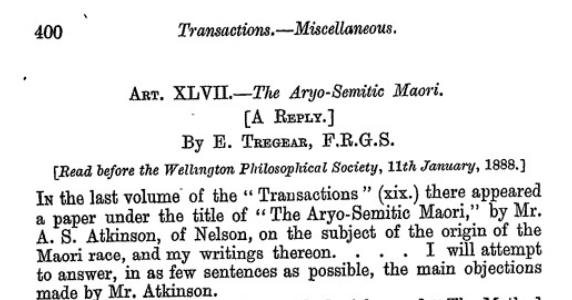
Their disagreement therefore involved competing understandings of linguistic evidence. While Atkinson emphasised systematic comparison and the need to distinguish genuine connections from accidental resemblance, Tregear defended a broader approach that prioritised phonetic similarities and ancient linguistic relationships. Although his response did not resolve Atkinson’s methodological criticisms, it demonstrates that Tregear remained committed to defending the intellectual foundations of his theory.
What makes the disagreement particularly interesting is that Atkinson was not challenging Tregear from outside New Zealand’s scholarly circles. Both men were part of the colony’s intellectual environment, and both were interested in using language to investigate Māori origins. At the beginning of his article, Atkinson states in a footnote that he rejects the label of a Māori scholar, describing himself instead as someone who had studied the language over a long period.[11] This distinction reflects his concern with the expertise required to make claims about Māori language and the confidence with which Tregear presented his conclusions.
Atkinson also highlighted the institutional standing of Tregear’s work. He noted that the Government Printing Office had published The Aryan Māori and that Tregear’s related paper, “The Māori in Asia”, had appeared in the Transactions of the New Zealand Institute.[12] These are Atkinson’s observations about the publication and circulation of Tregear’s work. Their significance can be interpreted separately: government printing and publication in a scholarly journal gave Tregear’s arguments visibility within recognised intellectual institutions, even though their appearance did not establish that his conclusions were correct.
Beneath the disagreement over linguistic evidence was a broader question about who had the authority to explain Māori origins. Both men treated Māori language as historical evidence, but their debate took place within European scholarly frameworks. Māori history was therefore being interpreted through methods and assumptions largely controlled by colonial intellectuals.
Although Atkinson challenged Tregear’s methodology, his criticism should not automatically be understood as a rejection of the wider racial assumptions underlying nineteenth-century scholarship. Both writers approached Māori origins through European intellectual categories. Historian M. P. K. Sorrenson notes that nineteenth-century studies of Māori origins helped make Māori a suitable subject for assimilation, with their so-called “long-lost Pākehā brothers,” though they often reached competing conclusions.[13] The controversy surrounding Tregear provides a specific example of these disagreements and the difficulties of establishing reliable explanations of the distant past.
The debate also formed part of a broader intellectual tradition linking Polynesian and Indo-European ancestry. As K. R. Howe explains, Tregear’s theory grew out of earlier ideas about the origins of Polynesian peoples in New Zealand and the Pacific Islands.[14] Its influence, therefore, cannot be understood solely through the immediate disagreement between the two writers.
The controversy surrounding The Aryan Māori reveals competing expectations about scientific evidence, but it also exposes the institutional and intellectual networks through which colonial knowledge gained authority. Atkinson challenged how Tregear reached his conclusions, but the debate remained situated within a colonial framework that gave European scholars considerable authority to interpret Māori history.
The next post considers why the idea of shared Aryan ancestry mattered for European understandings of Māori identity and the development of Pākehā national identity.
[1] A. S. Atkinson, “The Aryo-Semitic Māori,” Transactions and Proceedings of the New Zealand Institute 19, no. 1 (1886): 554.
[2] Atkinson, “The Aryo-Semitic Māori,” 558.
[3] Atkinson, “The Aryo-Semitic Māori,” 552.
[4] Atkinson, “The Aryo-Semitic Māori,” 554.
[5] Edward Tregear, The Aryan Māori (Wellington: George Didsbury, Government Printer, 1885), 31.
[6] Atkinson, “The Aryo-Semitic Māori,” 570; K. R. Howe, Singer in a Songless Land: A Life of Edward Tregear, 1846–1931 (Auckland: Auckland University Press, 1991), 56–57.
[7] Atkinson, “The Aryo-Semitic Māori,” 556.
[8] Lyle Campbell, “How to Show Languages Are Related: Methods for Distant Genetic Relationship,” in The Handbook of Historical Linguistics, ed. Brian D. Joseph and Richard D. Janda (Oxford: Blackwell, 2003), 263.
[9] “Our Book Shelf,” Nature 34 (July 29, 1886): 286.
[10] Edward Tregear, “The Aryo-Semitic Māori: A Reply,” Transactions and Proceedings of the New Zealand Institute 20 no. 1 (1887): 400–401.
[11] Atkinson, “The Aryo-Semitic Māori,” 552.
[12] Tregear, The Aryan Māori, 1; Edward Tregear, “The Māori in Asia,” Transactions and Proceedings of the New Zealand Institute 18 (1885): 3.
[13] M. P. K. Sorrenson, “The Whence of the Māori: Some Nineteenth Century Exercises in Scientific Method,” The Journal of the Polynesian Society 86, no. 4 (1977): 476.
[14] Howe, Singer in a Songless Land, 50.


Leave a Reply